
Let’s talk about how we can build your commerce project — tailored to your business, powered by Mercur
Many commerce teams still consider using Magento as the foundation for a marketplace. Mainly because it is powering around 8% of eCommerce sites worldwide.
Often the reasoning also goes like this: they already have a Magento store, and they know Magento developers – so why not build on top of what they already have?
Meanwhile, Magento stores declined 10% year-over-year in Q4 2025, and "what they already have" is a platform with no native support for multi-vendor marketplace architecture.
If you are considering building a marketplace in Magento, you will face a structural problem from day one. The platform does not support multiple sellers, split payments, vendor onboarding, seller dashboards, or commission management.
Every one of these capabilities must be added through third-party extensions or paid add-ons.
What you end up with is a system of plugins where marketplace logic sits on top of a monolith that was never designed for it.
In this article, you will see why Magento is the wrong foundation for a multi-vendor marketplace – the architectural limitations, the extension risks, and the operational friction that compounds over time. You will also find out what a purpose-built online marketplace platform should actually provide.
Key takeaways
- Magento has zero native marketplace functionality. Every marketplace capability must come from third-party extensions.
- The most common path (Webkul + add-ons) means assembling 5–15 paid plugins on top of a monolith that was designed for single-seller commerce. Each add-on adds upgrade risk, performance overhead, and a new dependency you do not control.
- Adobe Commerce licensing runs $22K–$125K/yr depending on GMV. Add extensions ($1,500–$3,000+), hosting, and specialist PHP development – your total cost of ownership is unpredictable and compounds with every new feature.
- PHP usage among developers dropped from ~30% (2021) to 19% (2025). Fewer engineers are entering the Magento ecosystem, making hiring slower and more expensive as your marketplace grows.
- The right marketplace platform should have multi-vendor logic in its core architecture, a predictable cost model, a technology stack you can hire for, and an API-first design that does not punish change.
- If you are starting a new marketplace, there is no architectural reason to choose Magento over platforms built for multi-vendor commerce from the ground up. If you already run a Magento store and want to add marketplace capabilities – plan the migration early, before the extension stack becomes too deep to unwind.
What is a marketplace, and what features does it need to provide?
A standard e-commerce store has one seller. You own the inventory, you set the prices, you fulfill the orders, and every transaction flows through a single business entity.
Magento, Shopify, WooCommerce – most eCommerce platforms were built for exactly this model.
A multi-vendor marketplace is a different architecture altogether. You operate the platform, but you are not the only seller.
Multiple independent vendors list products, manage their own inventory, set their own pricing, and fulfill their own orders – all within a single system that your buyers experience as one cohesive shop. Think Amazon, Etsy, or Airbnb.
The marketplace operator controls the rules, takes a commission, and orchestrates the experience. The vendors run their own businesses within that framework.
When you evaluate whether a platform can support a marketplace, you need to look at a specific set of capabilities. Here is what a multi-vendor marketplace requires at the platform level.
8 must-have features marketplace needs to provide
Below, you will find a closer look at each of these capabilities and why they matter.
Seller onboarding and approval
Your marketplace needs a structured process for bringing new vendors onto the platform.
That means the seller's transaction details, registration forms, identity verification (KYC), document collection, approval workflows, and configurable criteria for who gets accepted. You also need the seller approval functionality to reject, suspend, or tier sellers based on performance or compliance.
If onboarding is manual and admin-driven, your operations team becomes a bottleneck from day one.
Separate seller dashboard
Each vendor needs their own workspace independent from your admin panel and isolated from other sellers.
A marketplace seller dashboard should let vendors manage products, track orders, view their earnings, handle returns, and communicate with buyers. The quality of this interactive vendor dashboard directly affects seller adoption.
If your sellers cannot self-serve – add products, check their transaction details, or update their seller profile – your support team absorbs that workload instead.
Multi-vendor product and catalog management
Multiple vendors may sell the same product. You need product approval workflows, attribute normalization, duplicate detection, and category mapping across sellers.
The store admin needs to control which products go live, enforce quality standards, and manage a shared catalog without giving individual sellers the ability to break it.
A seller collection page, a seller shop with its own branding, and product-level attribution ("sold by Vendor X") all need to work natively.
Commission engine and split payments
Your revenue model depends on commission logic, and that logic needs to be flexible.
You may charge a flat percentage, a category-based rate, a tiered commission that changes with volume, or a per-vendor custom deal. The platform needs to calculate commissions automatically, generate payout reports, and split payments at the transaction level.
When a buyer places an order with products from different sellers, the payment must be divided correctly between the marketplace operator and each vendor.
Multi-vendor order management
A single order on your marketplace can contain products from multiple sellers. Each seller needs to fulfill their own portion independently with their own shipping methods, tracking numbers, and delivery timelines.
Your order management system must support order splitting, per-vendor fulfillment tracking, seller-specific SLAs, and partial refunds.
The buyer sees one order. Behind the scenes, the system routes each item to the responsible vendor and tracks it separately.
Marketplace analytics and reporting
You operate at two levels: the marketplace as a whole and each individual vendor. Your reporting needs to reflect both.
- You need aggregated GMV, take rate, active sellers, order volume, and dispute rates at the platform level.
- Each vendor needs access to their own sales reports, traffic to their seller profile page, top selling categories, and payout history.
- Finance teams need reconciliation reports that match commissions, payouts, refunds, and fees.
A single-seller analytics setup does not cover this, you need marketplace-native reporting from the start.
Ratings, reviews, and trust systems
Buyers on a marketplace are purchasing from vendors they may not know. You need seller-level ratings and reviews (separate from product reviews) to build trust.
A seller's reputation score, response time, fulfillment rate, and return rate all feed into how prominently they appear in search results and whether they retain their selling privileges.
Your platform should support seller reviews, product reviews with seller attribution, and moderation tools for the store admin.
Dispute resolution and return handling
When something goes wrong on a marketplace, the question of responsibility is more complex than in a single-seller store. Was the item shipped late by the vendor? Was it damaged in transit? Did the product match the listing?
Your platform needs a dispute workflow that involves the buyer, the vendor, and the marketplace operator. Return policies may vary by seller. Refunds may need to be partially funded by the vendor's commission balance.
None of this works if your system treats every transaction as a simple two-party exchange between "the store" and "the customer."
Now that you know what a multi-vendor marketplace actually requires, let's see how Magento attempts to deliver it (and where that attempt falls apart).
How Magento "supports" the marketplace business model: Magento marketplace extensions
Magento – both the open-source version and Adobe Commerce – ships with zero marketplace functionality.
There is no seller registration, no vendor dashboard, no commission engine, no split payment logic, and no multi-vendor order management anywhere in the core platform.
The Adobe Commerce Marketplace (the official extension store) lists over 3,000 extensions across all categories, but none of them are first-party marketplace modules from Adobe itself.
If you want to run a multi-vendor marketplace on Magento, your only path is through third-party marketplace extensions.

The ecosystem here is narrow. A handful of vendors offer Magento marketplace modules, and in practice, most implementations you will encounter rely on one dominant player.
Webkul Multi Vendor Marketplace
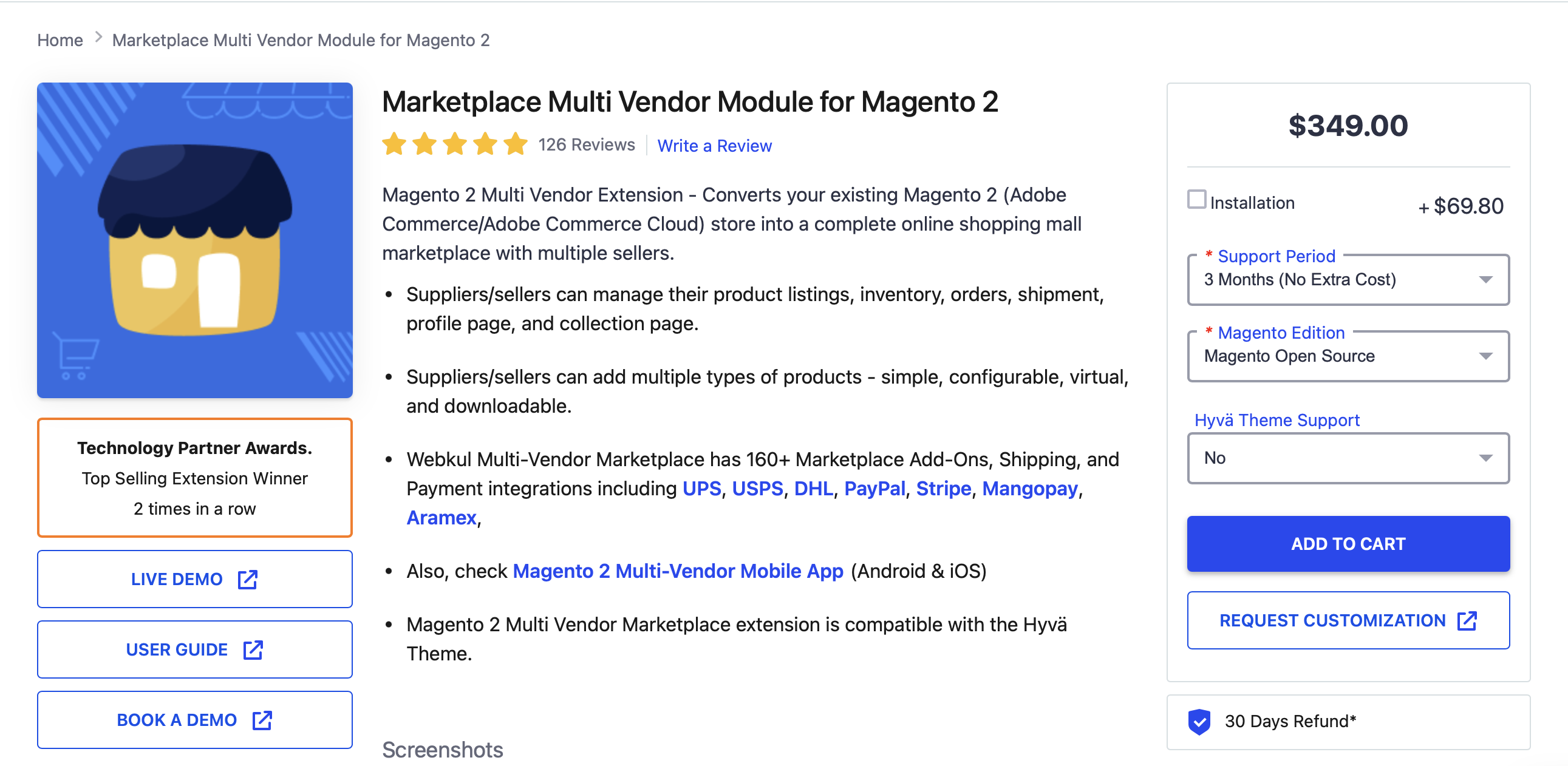
Webkul is the de facto standard for building a marketplace in Magento. Their Multi Vendor Marketplace module is the most widely deployed marketplace extension in the Magento ecosystem.
The base module costs $349 for Magento Open Source with an additional $349 if you run your store on Adobe Commerce.
It provides the foundational layer: a separate vendor dashboard, seller profile pages, basic commission management, and store admin management.
On paper, this covers the basics. In practice, the base module alone will not give you a fully functional marketplace. You will need paid add-ons – and Webkul has built over 100 of them for Magento 2 alone.
- Split payments? Separate add-on (Stripe Connect, PayPal, Mangopay – each a different module).
- Seller-specific shipping (FedEx, UPS, USPS, table rate)? Separate add-ons.
- RMA and return management? Add-on.
- Seller-level advanced reporting to display sales reports? Add-on.
- Mass product upload for sellers? Add-on. Marketplace landing page customization? Add-on.
- Buyer-seller communication? Add-on.
Each module carries its own license cost, its own update cycle, and its own compatibility constraints with both the Webkul base module and Magento core. You are assembling your marketplace feature set one paid plugin at a time.
Other Magento marketplace extensions
A few other vendors offer Magento 2 multi-vendor marketplace extensions, though with smaller install bases and narrower ecosystems:
- CedCommerce is the second most recognized name in the Magento marketplace extension space. Their Magento 2 Multi Vendor Marketplace module offers a similar feature set to Webkul with a stronger focus on B2B capabilities.
- Apptha provides a multi-vendor module priced at $999 with around 56 add-ons, fewer than Webkul but still following the same modular approach.
- CreativeMinds offers a marketplace extension oriented toward vendor reviews and SEO optimization for seller pages, targeting a lighter marketplace setup.
- Magenest and Magetop round out the field with lower-priced alternatives that cover core vendor management and product approval functionality, though with smaller support teams and less frequent update cycles.
What every option has in common
Regardless of which Magento marketplace extension you choose, the architecture remains the same: you are layering third-party plugin code on top of a platform that was designed for single-seller commerce.
The marketplace logic lives entirely in extension code, not in Magento's core data model or API layer.
For a small pilot with a few vendors selling simple products, this can work.
Where it starts to break is at scale – when you have dozens of sellers, thousands of SKUs, complex commission rules, and a Magento admin panel that has to coordinate with five or ten interdependent extensions on every order.
That is where we go next. In the following section, you will see exactly why this extension-based approach hits a wall and what specific limitations you will run into when you try to run a real multi-vendor marketplace on Magento.
The limitations listed below come from our own technical analyses, conversations with eCommerce teams who have built (or attempted to build) marketplaces on Magento, discussions across developer communities, and publicly available data from industry reports.
Why Magento breaks for multi-vendor marketplaces: 14 Magento marketplace limitations
The previous section covered what is available. This section covers what happens when you actually try to run a multi-vendor marketplace on Magento.
Each limitation below is a structural problem, not a configuration issue you can fix with better hosting or another plugin.
1. No native marketplace support
This is the root of every other problem on this list. Magento was architected as a single-seller eCommerce platform. Its data model, API layer, admin panel, and order management system all assume one merchant owns the entire catalog.
There is no concept of a "seller" in Magento's core schema. No vendor entity, no seller-level permissions, no commission logic, no multi-party transaction model.
When you install a marketplace extension like Webkul, you are adding seller management on top of a system that has no native awareness of multiple sellers.
The extension creates its own database tables, its own admin interfaces, and its own API endpoints – all running in parallel with Magento's core, not integrated into it. Any update to one extension can break others. A Magento core patch can break all of them simultaneously.
The more modules in your stack, the larger the surface area for conflicts, the longer the QA cycle for every release, and the higher the risk of production incidents.
What this means for your business: You are not running a marketplace platform. You are running a single-seller eCommerce store with a multi-vendor layer bolted on top. Your marketplace's stability is only as strong as the weakest extension in your stack. You do not control the release schedules, code quality, or compatibility testing of these third-party modules.
2. High total cost of ownership
The costs of a Magento marketplace stack up from multiple directions.
If you go with Adobe Commerce, licensing alone starts at $22,000/year and can exceed $125,000/year depending on your GMV/AOV. If you use Magento Open Source, you avoid the license fee, but you also lose access to Adobe's B2B modules, cloud hosting, and dedicated support.
On top of the platform cost, you are paying for marketplace extensions. A baseline Webkul setup – base module, split payments, seller shipping, RMA, and advanced reporting – can easily reach $1,500–$3,000 in license fees before any customization. Each add-on carries its own annual renewal or support cost.
Then add hosting, specialist PHP development, and the ongoing cost of managing extension compatibility across every upgrade. Full implementation costs for Adobe Commerce commonly exceed $150,000–$200,000.
What this means for your business: Your total cost of ownership is unpredictable and compounds over time. Every new marketplace feature requires evaluating extension costs, dev hours, and compatibility risk before you write a single line of business logic.
3. PHP technology declining
Magento is built on PHP. The Stack Overflow Developer Survey 2025 showed that only 19.1% of professional developers use PHP – down from around 30% in 2021. Among developers learning to code, just 14.5% chose PHP.
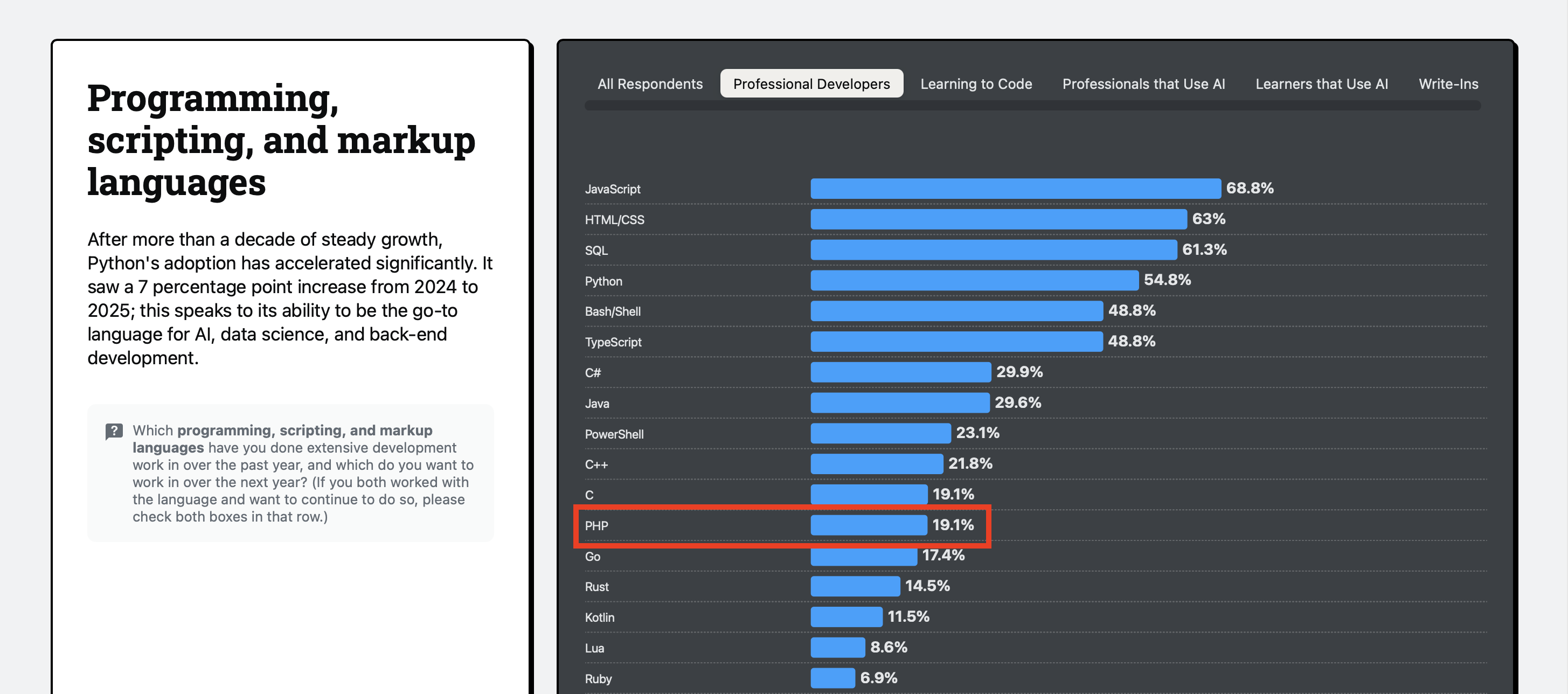
In "desired" language rankings, only about 9% of developers want to try PHP, and fewer than half of current PHP developers want to continue using it.
The practical consequence: Magento developers are harder to find and more expensive to hire. Fewer junior developers are entering the PHP ecosystem. The agencies that specialize in Magento are shrinking along with the platform's market share.
What this means for your business: You are building on a technology stack with a contracting talent pool. As your marketplace grows and you need to hire or scale your engineering team, you will compete for a shrinking supply of specialists at premium rates.
4. Adobe neglects the open-source version
Magento Open Source still receives security patches and bug fixes. However, Adobe no longer introduces new features or functionalities to the open-source edition.
All recent and future feature development for Adobe Commerce is delivered as SaaS-based add-ons with no open-source code.
The community has noticed. Mage-OS, an independent fork of Magento Open Source, was created specifically because the community sees a lack of focus on Magento Open Source development from Adobe's side.
BuiltWith shows that the absolute number of live sites is still significant, but the trend line is consistently downward and Adobe Commerce is losing net customers to composable and SaaS alternatives.
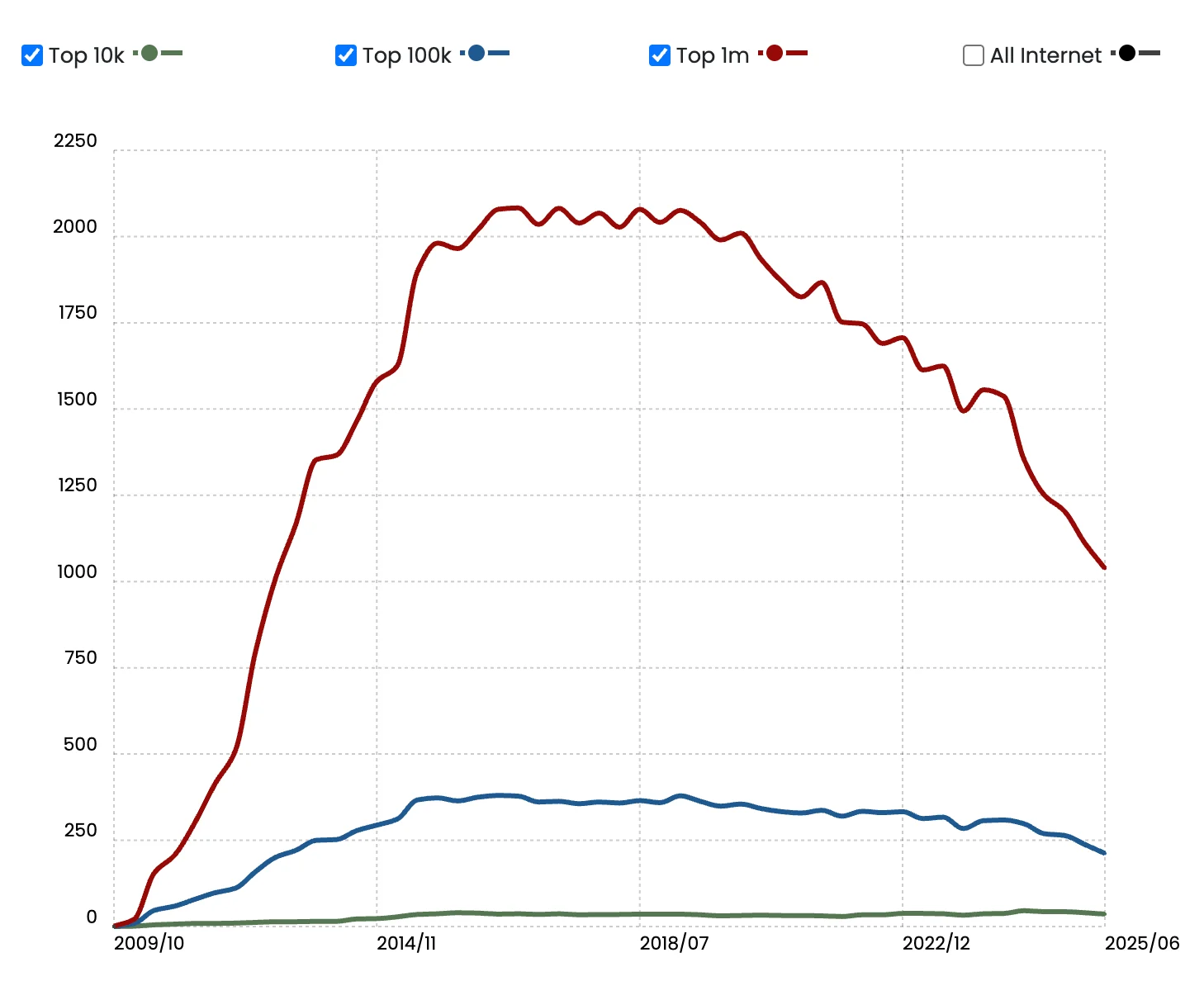
What this means for your business: If you build your marketplace on Magento Open Source to avoid licensing costs, you are betting on a platform whose owner has deprioritized it. If you pay for Adobe Commerce, you are paying premium prices for a platform that is losing market share. Neither path offers long-term confidence.
5. Poor performance and scalability
Magento is a resource-intensive platform even in single-seller mode.
Add marketplace extensions, and the performance picture degrades further. Each module works independently, re-requesting data that other modules have already fetched. The more add-ons in your stack, the more database queries, the more observer events, and the slower your admin panel and storefront become.
Our API performance tests showed that Magento is up to 6.5× slower than Medusa. When we ran a product fetch for 15 items across 50 concurrent users over 30 seconds, Magento averaged a 20,330 ms response time. Medusa handled the same scenario in 2,900 ms – seven times faster.
What this means for your business: Your operations team will feel this first. The admin panel slows down with every extension you add – product management, order processing, and inventory updates take longer. Your buyers will feel it next: slow checkout, slow search, and slow category pages. Both translate directly to lost revenue and higher operational costs.
6. Monolithic architecture with limited headless capability
Magento uses a monolithic PHP architecture with tightly coupled frontend, backend, and database layers.
In a monolithic system, changing one layer risks breaking others. If you modify the checkout flow for marketplace-specific logic (split payments, per-vendor shipping selection), you are touching the same codebase that handles single-seller checkout, cart calculations, and tax rules.
Extension conflicts compound this: a Webkul checkout modification can collide with a payment gateway extension, a tax module, or Magento's own checkout updates in the next patch.
True headless commerce – where you build a custom frontend and communicate with the backend purely through APIs – is technically possible with Magento, but it requires significant engineering investment, and you will encounter API gaps for marketplace-specific operations that do not exist natively.
What this means for your business: Your development velocity is limited by the platform's architecture. Frontend and backend teams cannot work independently. Every release carries regression risk.
7. Complex and expensive customization
A multi-vendor marketplace is not a standard eCommerce store with a few tweaks. You need custom onboarding flows, dynamic commission models, seller-specific promotions, marketplace-level analytics, and buyer-facing features.
Every nonstandard feature requires specialist development or an add-on. But adding one new module can destabilize others, especially during Magento version upgrades when extension compatibility is not guaranteed.
What this means for your business: Your development costs grow non-linearly. The first marketplace feature is expensive. The tenth is even more expensive, because every addition must be tested against a growing stack of interdependent extensions and customizations.
8. Constant painful upgrades
Magento releases new versions roughly every quarter. For a Magento marketplace with a ton of extensions from multiple vendors, every upgrade is a project.
You need to verify that every marketplace extension is compatible with the new Magento version. Webkul, CedCommerce, and other vendors release their own updates on their own timelines.
If one extension is not yet compatible, you either wait (and run an outdated Magento version with known vulnerabilities) or proceed without that extension (and lose marketplace functionality).
Security patches are especially painful. They cannot wait, but they routinely break custom code and extension functionality. Instead of one developer managing the store, you end up with a team dedicated to understanding and resolving conflicts across the entire extension stack.
What this means for your business: Upgrades become a recurring cost center. Each major update requires regression testing across your entire marketplace stack. Delays in upgrading expose you to security vulnerabilities. The more extensions you have, the longer upgrades take and the higher the risk of breaking production functionality.
9. Security vulnerabilities
Magento's security track record has been consistently problematic, and the pace of critical vulnerabilities has not slowed.
- In 2024, Magento sites accounted for 0.71% of all eCommerce attacks – a disproportionate share given its declining market position.
- In June 2024, the CosmicSting vulnerability (CVE-2024-34102, CVSS 9.8/10) allowed unauthenticated attackers to read any file on the server, steal encryption keys, and gain full admin API access. Seven attacker groups exploited it, injecting payment skimmers into over 4,000 stores.
- In October 2025, another critical vulnerability (CVE-2025-54236, CVSS 9.1) was actively exploited in the wild. Attackers used the flaw to upload PHP webshells and hijack customer accounts through the REST API.
For a marketplace operator, the stakes are higher than for a single-seller store. A security breach exposes not just your data but also your vendors' data, your buyers' payment information, and your entire commission and payout infrastructure.
What this means for your business: You are responsible for the security of every vendor and buyer on your platform. Magento's patch cadence, combined with the difficulty of upgrading extension-heavy installations, creates a window of exposure after every disclosure. The marketplace model amplifies the damage of any breach.
10. Limited analytics and tracking
Magento's built-in reporting is designed for a single store owner. It gives you aggregated revenue, order counts, and basic product performance. It does not give you marketplace-level analytics.
Marketplace-specific reporting (e.g., seller-level sales reports, commission reconciliation, payout summaries, vendor dispute rates) requires add-ons or custom development.
For your finance team, this means manual reconciliation between Magento order data, extension-generated commission reports, and your actual payment provider payouts. For your marketplace operators, it means limited visibility into seller health, catalog quality, and buyer satisfaction metrics.
What this means for your business: You cannot run a marketplace without marketplace analytics. Magento does not provide them natively, and the extension-based alternatives are limited in depth and reliability. You will spend development hours building custom reporting or accept that your operational visibility is incomplete.
11. Integration problems
A marketplace sits at the center of multiple business systems: ERP for financials and inventory, PIM for product data, CRM for seller and buyer relationships, shipping providers for fulfillment, and payment platforms for multi-party transactions.
For example, connecting your ERP to a Magento marketplace means syncing data across three layers: Magento core, the marketplace extension, and whatever additional add-ons you use (shipping, payments, RMA).
Each layer has its own data model and update cadence. Handling external data from ERP, CRM, PIM, and shipping is painful, and complex dependencies across systems make integrations a maintenance nightmare.
What this means for your business: Every integration you build against a Magento marketplace is fragile. Extension updates can break API contracts. Magento upgrades can change core behavior. You will spend significant engineering time maintaining integrations rather than building new marketplace capabilities.
12. Slow admin panel
This is the operational reality of running a Magento marketplace day-to-day. The Magento admin panel was not fast to begin with, it is a server-rendered PHP interface that makes full-page requests for most actions.
After adding extensions, the store management panel becomes painfully slow due to additional data.
- Product saves take longer because marketplace observers fire on every save event.
- Order grids are slower because they pull vendor data alongside order data.
- Configuration pages become cluttered with extension-specific settings.
Your operations team works in this panel every day. Every additional second of load time on admin pages compounds into hours of lost productivity per week.
What this means for your business: A slow admin panel directly affects how fast your team can onboard sellers, approve products, resolve disputes, and process orders. In a marketplace where operational speed determines seller satisfaction and buyer experience, a sluggish backend is a competitive disadvantage.
13. No dedicated business support
Direct support from Magento is limited or inaccessible for smaller merchants.
Your only resources are community forums, Stack Overflow, and whatever documentation Adobe maintains. There is no SLA, no account manager, no guaranteed response time.
Adobe Commerce includes 24/7 technical support and a dedicated account manager, but at the $22,000–$125,000/year license cost mentioned earlier. Even then, Adobe's support covers the platform, not your marketplace extensions.
When a Webkul module conflicts with a Magento patch, neither Adobe nor Webkul may take ownership of the resolution. You are left coordinating between vendors, and the resolution timeline is outside your control.
What this means for your business: When your marketplace goes down at 2 AM, you need to know who to call. With Magento Open Source, the answer is your own team. With Adobe Commerce, the answer is Adobe for core issues and "figure it out" for extension conflicts. Neither scenario gives you the support reliability a marketplace operator needs.
14. PHP incompatible with AI-assisted development
This limitation is becoming increasingly relevant as AI coding tools reshape how software gets built. Magento's PHP codebase is increasingly difficult to develop with using modern AI/LLM tooling (like GitHub Copilot, Cursor, and Claude).
AI models are trained predominantly on JavaScript and Python codebases. PHP receives weaker code suggestions, less accurate completions, and slower iteration in AI-assisted development environments.
As teams across the industry accelerate their development velocity with AI tooling, Magento developers are left with tools that work less reliably for their stack.
What this means for your business: Your competitors building on JavaScript-based or Python-based stacks can iterate faster using AI-assisted development. Your Magento development team faces lower AI tool quality, which means slower feature delivery and higher per-feature development costs – a gap that will widen as AI coding tools continue to improve.
What the right online marketplace platform should give you
You already know what marketplace features to look for. The harder question is whether the platform's architecture, cost model, and ecosystem will still work for you in two years.
Below are the business-level factors that separate a platform you can scale on from one you will eventually need to migrate away from.
Marketplace logic in the core, not in plugins
The single biggest lesson from the Magento section above: If marketplace functionality is bolted on through extensions, you inherit every limitation of that approach – upgrade fragility, extension conflicts, performance degradation, and a support model where no single vendor owns the full stack.
The right platform should treat multi-vendor commerce as a first-class architectural concept. Sellers, commissions, split payments, and per-vendor order routing should exist in the platform's data model and API layer from the start.
You should not need a third-party module to create a seller or split an order.
Predictable and transparent total cost of ownership
Your CFO should be able to model the cost of running your marketplace over three years without spreadsheet acrobatics.
That means no GMV-based licensing surprises, no extension stacking where each new capability adds another annual fee, and no hidden cost of "specialist developers" because the platform runs on a niche technology.
Look for platforms where the core marketplace functionality ships without per-feature licensing and where development and hosting costs are proportional to your actual usage, not to your revenue tier.
A technology stack your team can hire for
Your marketplace will need engineers for as long as it exists. The platform's language, framework, and tooling should align with where the developer market is heading.
JavaScript and TypeScript dominate modern web development. Python leads in AI/ML and data engineering. Both have deep talent pools, active open-source ecosystems, and strong compatibility with AI-assisted development tools (Copilot, Cursor, Claude).
If your platform runs on a stack that junior developers are actively learning and senior developers want to work with, you will hire faster, onboard cheaper, and retain longer.
Modular architecture that does not punish change
A marketplace roadmap is never finished. You will add new commission models, new buyer-facing features, and new integrations with ERPs and payment providers. Every one of those changes should be possible without risking the stability of everything else.
That requires a modular or composable architecture, where you can modify the checkout without breaking the catalog, update the commission engine without redeploying the storefront, and add a new payment provider without regression-testing the entire admin panel.
If every change requires a full-stack deployment and cross-extension QA, your iteration speed will decrease as your marketplace grows.
API-first design for integrations and frontend flexibility
The platform's API layer needs to be complete, consistent, and stable across versions.
Every marketplace operation should be available through the API with the same reliability as the admin interface.
If you need to work around API gaps with direct database access or custom middleware, your integration costs will compound with every connected system.
Fast time-to-market with iterative deployment
Marketplace success depends on how quickly you can get to market, test assumptions with real sellers and buyers, and iterate based on what you learn.
If your platform requires a six-month implementation before you can onboard your first vendor, you are burning runway before you have validated your model.
The right platform should let you launch an MVP marketplace in weeks. From there, you should be able to layer on advanced features (dynamic commissions, custom analytics, and seller tiers) incrementally, without re-architecting what you already shipped.
Security as a platform responsibility, not an ops burden
Your platform should have a clear, responsive patch cadence and an architecture where applying updates does not require coordinating compatibility across a stack of third-party modules.
Look for platforms with a small, auditable dependency surface, proactive vulnerability disclosure, and an upgrade path that does not force you to choose between "apply the security patch" and "keep your marketplace features working."
A community and ecosystem that is growing, not contracting
Platform health is visible in the trajectory of its community.
Are new developers joining? Are agencies building practices around it? Is the open-source contribution rate increasing or declining? Are merchants adopting or migrating away?
A growing ecosystem means more shared knowledge, more available integrations, faster bug resolution, and a stronger hiring pipeline.
Modern foundations to consider
The marketplace platform market has shifted. A new generation of open-source, API-first platforms now offers the architectural depth that used to require enterprise licensing, without locking you into a monolithic stack or a SaaS vendor's roadmap.
The strongest options combine modular architecture with full infrastructure ownership. You control the backend, the data, and the deployment model. You extend the platform through code, not through plugin stacking.
Mercur is one example. It is an open-source marketplace platform built for companies that have outgrown extension-based setups. It ships with native multi-vendor functionality – admin panel, vendor panel, storefront, commission engine, and order splitting – on a modular architecture designed for custom workflows.

You own the code, you own the data, and you can adapt every layer to your specific market without waiting for a third-party vendor to release a compatible add-on.
If you are evaluating marketplace platforms and want a structured comparison, our free guide – Top 11 Multi-Vendor Marketplace Platforms for eCommerce – compares leading technologies (including Mercur) across 11 criteria: pricing, deployment model, customization depth, native marketplace features, and more.
It is a practical starting point for narrowing down which foundation fits your business.
And if you are still early in the process – validating a marketplace idea, planning the architecture, or deciding whether to migrate from an existing platform – reach out to our team.
We work with companies building multi-vendor marketplaces, B2B marketplaces, B2C marketplaces, and MVP marketplace launches. We will help you map the right technology to your specific model.
Conclusion: Should you create a marketplace in Magento?
At this point, you have seen the full picture – what a multi-vendor marketplace requires, how Magento attempts to deliver it through third-party extensions, and the 14 structural limitations that make that approach fragile, expensive, and difficult to scale.
Here is what it comes down to.
Magento is a capable single-seller eCommerce platform. For a standard online store with one merchant, one inventory, and one checkout flow, it can work.
A multi-vendor marketplace is a fundamentally different system. It needs native seller management, split payments, per-vendor order routing, commission logic, and multi-party data isolation – at the platform level, not in a stack of plugins.
Magento does not provide any of this natively, and the extension-based workarounds introduce compounding risk across performance, security, upgrades, and operational complexity.
If you already run a Magento store and are exploring the idea of adding a marketplace layer, the honest assessment is you can make it work for a small pilot with a few vendors and simple products.
You will struggle the moment you need to scale: more sellers, more SKUs, complex commissions, real-time split payments, and the operational tooling that a growing marketplace demands.
If you are starting a new marketplace project from scratch, there is no architectural reason to choose Magento over platforms that were built for multi-vendor commerce from the ground up.
The marketplace platform market has matured. Open-source, API-first, modular platforms now exist that give you the flexibility of self-hosted infrastructure with native marketplace architecture.
If you are evaluating whether to build, migrate, or scale a marketplace – schedule an honest technical conversation with our marketplace experts! We will help you find the right foundation for your specific business model.
FAQ on marketplace in Magento
Is Magento a marketplace?
No, Magento is a single-seller eCommerce platform, not a marketplace. Its core architecture supports one merchant managing one product catalog, one checkout, and one order flow. There is no native concept of multiple sellers, vendor dashboards, commission engines, or split payments in Magento's data model.
To turn a Magento store into a multi-vendor marketplace, you need to install third-party marketplace extensions like Webkul Multi Vendor Marketplace or CedCommerce. The result is a marketplace built through plugins, not a platform designed for multi-vendor commerce from the ground up.
What is the difference between a website and a marketplace?
A standard eCommerce website is operated by a single seller. You own the products, set the prices, fulfill the orders, and handle all customer interactions. One business entity controls the entire experience from catalog to checkout to delivery.
A marketplace is a platform where multiple independent sellers list and sell their products through a single storefront. The marketplace operator manages the platform, sets the rules, and takes a commission on transactions. Each seller manages their own inventory, pricing, and fulfillment through a seller dashboard. Buyers see one cohesive shopping experience, while behind the scenes, orders are split and routed to the responsible vendors.
How to build a marketplace website in Magento?
Building a marketplace in Magento requires installing a third-party multi-vendor marketplace extension on top of your Magento store. The extension-based architecture introduces structural limitations around performance, upgrade complexity, security, and scalability that become increasingly painful as your marketplace grows. For new marketplace projects, purpose-built marketplace platforms offer a more sustainable foundation.
What is the Magento Marketplace?
The term "Magento Marketplace" can refer to two different things, which often causes confusion.
Adobe Commerce Marketplace is Adobe's official extension store, a directory of third-party extensions, themes, and connectors that you can install on your Magento store.
A marketplace built on Magento refers to using Magento as the underlying platform for a multi-vendor eCommerce marketplace, where multiple sellers list products and sell through a shared storefront. This requires installing third-party Magento marketplace extensions (like Webkul or CedCommerce) because Magento does not include native multi-vendor marketplace functionality.
