Turn your Magento eCommerce into a multi-vendor marketplace with a Magento marketplace extension
Mercur is a multi-vendor marketplace platform that connects to your eCommerce as a Magento marketplace extension – adding vendor workflows and marketplace logic, while Magento stays your core commerce engine.
- No migration, no replatforming, no vendor lock-in
- No need to pause current eCommerce development
- Magento remains your product, checkout, and ERP backbone
- Mercur handles vendors, commissions, and marketplace logic
- API-first, headless-ready architecture for Magento setups
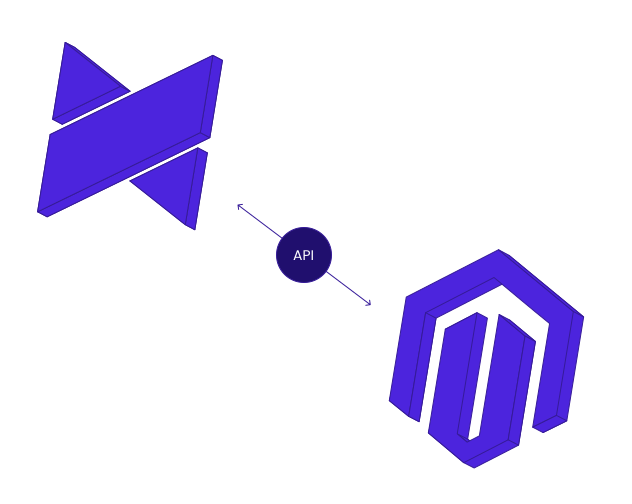
Is the Magento + Mercur marketplace extension setup for you?
This Magento marketplace extension setup is designed for Magento store owners who want to grow from a classic e-commerce business into a scalable online marketplace model – without risking their existing ecosystem.

- You wish to add multiple vendors, partners, or suppliers to your platform
- You need to expand product listings without holding inventory
- You want to explore dropshipping or partner-based models

- Magento is already your stable commerce foundation
- Your marketplace logic is becoming too complex for custom Magento extensions
- You want to scale sellers, not just products

Why choose Mercur as a Magento marketplace extension
Mercur works as a marketplace platform connected to Magento. It supports your long-term growth without risking changes to your existing Magento commerce core.
Reduce development and maintenance costs by keeping marketplace logic out of Magento.
Adding marketplace features to a Magento store requires paid add-ons and continuous development. With Mercur, you avoid recurring vendor fees and lock-in, while keeping full ownership with open code to customise limitless.
Operate your marketplace on top of Magento with full platform ownership.
Mercur keeps marketplace responsibilities separate from the Magento core, with predictable integration points, and no vendor lock-in at the marketplace layer.
Work with classic Magento storefronts as well as headless frontends.
Mercur connects to Magento through APIs and event-based communication, so seller accounts, product listings, and marketplace rules remain stable even when storefront technology changes.
Develop your Magento store and Mercur marketplace independently, without one limiting the other.
Marketplace logic runs in Mercur, so growing numbers of sellers, rules, and workflows do not interfere with Magento performance or core commerce operations.
Keep your marketplace running even if your long-term roadmap includes changes to frontend, checkout, or commerce engine.
Mercur remains your engine while Magento can be replaced gradually, without breaking marketplace logic.
How Magento and Mercur work together
Mercur does not replace Magento. It acts as a multi-vendor marketplace extension that integrates with your existing Magento stack.

- Commerce backbone
- Core product catalog (single- or multi-source)
- Checkout and payment flow (optional)
- ERP, PIM, OMS, and tax integrations
- Existing frontend or headless storefront

How they communicate
API-first integration
Event-based synchronization Headless-friendly by design
Systems can scale independently

- Vendor and store admin management
- Multi-vendor product offers
- Commission, fees and payout rules
- Order splitting per seller
- Seller onboarding and workflows
Magento remains your commerce backbone.
Mercur isolates marketplace complexity - so both systems can scale independently.
Discover Magento + Mercur marketplace capabilities
Magento is an excellent commerce engine, but building and scaling a true multi-vendor marketplace on top of it usually means heavy custom development and paid extensions.
Mercur fills this gap with a dedicated marketplace layer on top of a Magento e-commerce store. Marketplace logic runs separately from the Magento core, allowing Magento to stay focused on commerce while Mercur handles multi-vendor operations.

Create a Magento marketplace where multiple sellers can offer the same product with different prices, stock levels, and conditions. Product offers stay vendor-specific, while the Magento catalog remains clean and consistent.
.svg)
Give each vendor their own seller dashboard to manage products, orders, vendor reviews, refund requests, and availability. Store admins keep full control over marketplace workflows, while vendors manage their daily operations without access to other admins or sellers' profile.
.svg)
Define commission rules, fees, and settlement models, per vendor or category. Handle them outside the Magento core, reducing custom development inside the eCommerce platform.
.svg)
Customers place a single order through the Magento checkout. Order details are automatically split into seller-specific orders, with separate fulfillment, shipping, and refund flows for each vendor.
.svg)
Manage vendor registration through structured onboarding workflows. Verification steps, contract handling, and seller activation are designed for automated operations.
.svg)
How companies use Magento + Mercur in practice
If your business model involves multiple sellers, suppliers, or partners – Magento + Mercur gives you the structure to scale it safely.
This setup is already proven across retail expansion, complex B2B marketplace platforms, and other marketplace models.

A classic Magento store opens its platform to third-party sellers to increase product range without increasing inventory or operational risk.
A strong brand invites selected partners or manufacturers to sell through its existing Magento storefront – under full platform control.

Why marketplace logic shouldn't live entirely in your Magento core
Magento is powerful, but native marketplace support was never part of its core design. Extending it too far often leads to long-term complexity and rising maintenance costs.
Mercur allows Magento to stay great at what it does best, while your marketplace evolves as a product of its own.

Custom marketplace logic tightly coupled to the core
Increasing upgrade and maintenance complexity
Harder to scale sellers independently from commerce
Marketplace features compete with core online platform priorities

Clear separation of concerns
Marketplace logic isolated and extensible
Easier scaling of vendors, rules, and workflows
Freedom to evolve the marketplace without destabilizing commerce
Built for today's Magento - ready for tomorrow's platform
Magento + Mercur is not a dead-end architecture. It's a modular setup designed to evolve together with your business, traffic and platform strategy.

Marketplace complexity grows independently from your core commerce logic. More sellers, more rules, more workflows - without slowing down Magento.
Mercur integrates through APIs and events, making it compatible with both classic Magento frontends and modern headless setups.
If your long-term roadmap includes changing checkout, frontend or even core commerce: Mercur can remain your marketplace engine while Magento can be gradually replaced, not ripped out.
Magento marketplace development process
Adding the marketplace to Magento eCommerce doesn’t have to be a multi-year transformation. The Magento marketplace extension can be rolled out step by step, starting with a focused MVP.
- No big-bang replatforming
- No need to pause current eCommerce development
- Marketplace can grow at your pace
Define your marketplace model, seller types, commission logic, and integration scope with our expertise.
Get a clear split of responsibilities between Magento and Mercur, aligned with your existing ERP, PIM, and OMS.

Start building your Magento marketplace today
Connect your Magento commerce foundation with Mercur to turn it into a scalable marketplace platform.
- Discuss your marketplace model and constraints
- Understand Magento’s real limits for your use case
- Validate if Magento + Mercur is the right fit
- Get a high-level architecture recommendation: Magento + Mercur, Shopify + Mercur, or custom